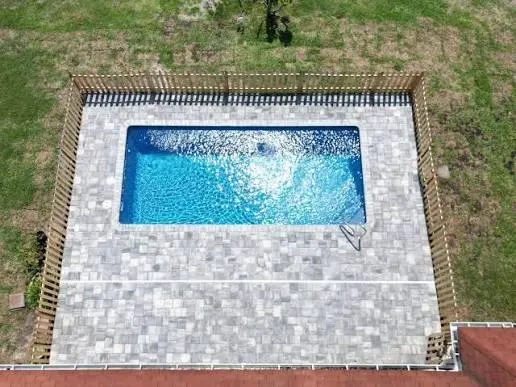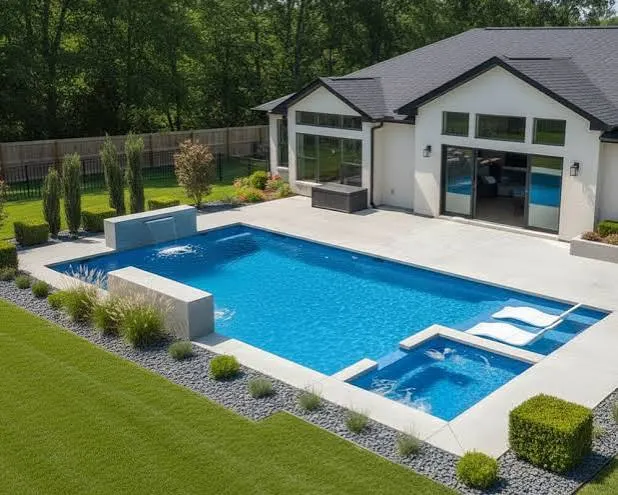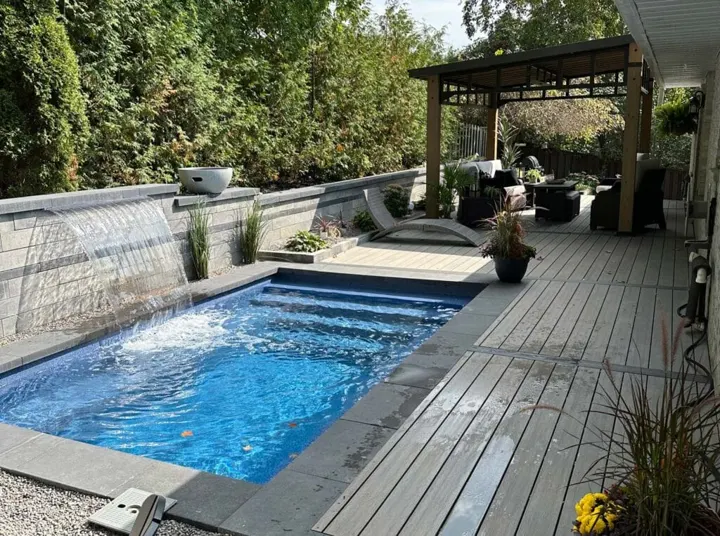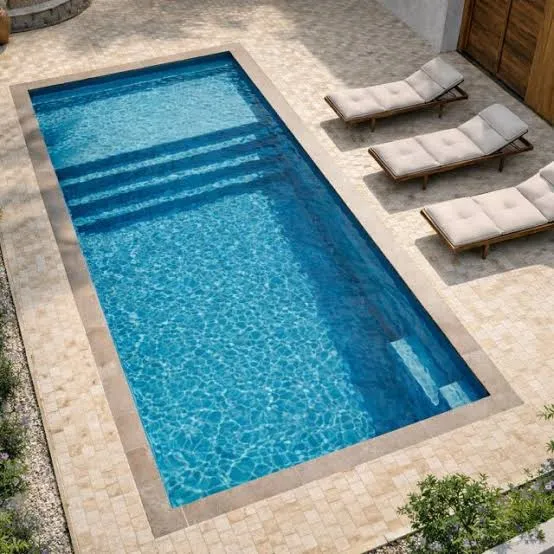
If you’re planning a pool in Central Florida, you’ll hear about three types: fiberglass, concrete (also called gunite or shotcrete) and vinyl liner. Each can give you a beautiful backyard. They’re just built very differently — and those differences show up in how long installation takes, how much time you spend on maintenance, and what you’ll pay over the life of the pool.
Here’s a straight comparison from the people who install them.
The short version
| Fiberglass | Concrete (gunite) | Vinyl liner | |
|---|---|---|---|
| How it’s built | One-piece shell made in a factory, set in your yard | Steel and sprayed concrete formed on site, then plastered or tiled | Wall panels and a vinyl liner installed on site |
| Typical install time | Fastest — weeks, not months | Longest — often several months | In between |
| Surface feel | Smooth gelcoat | Textured plaster (smooth with tile or pebble upgrades) | Soft vinyl |
| Algae resistance | High — non-porous surface | Lower — porous plaster | Moderate |
| Shape options | Choose from manufacturer models | Fully custom | Many shapes, limited by liner |
| Long-term upkeep | Lowest | Resurfacing over the years | Liner replacement over the years |
Fiberglass pools
A fiberglass pool is manufactured as a single shell in a controlled factory environment, then delivered and lowered into an excavated hole on a prepared base. At Sun Harbor we install X-Pools shells — models like the Key West, Miami and X Line Spa.
Why homeowners choose it:
- Speed. Because the shell arrives finished, there’s no on-site forming, spraying or curing. That’s a big reason we can plan a complete project in 50 days, permits included.
- Low maintenance. The gelcoat surface is smooth and non-porous, so algae has a hard time holding on. Most owners brush less and use fewer chemicals than with plaster.
- Comfort. No rough plaster on feet or knees — kids love it.
- Built-in features. Steps, benches, lounge areas and even integrated spas are molded into the shell.
The trade-offs:
- Shapes and sizes are set by the manufacturer. You choose from a collection rather than drawing any shape you want. (The good news: a well-designed collection covers most yards — our models range from a 7′4″ spa to a 29′6″ pool-and-spa.)
- Access matters. The shell is delivered by truck and set by crane, so the route into your backyard needs planning. We check this at your free consultation.
Concrete (gunite) pools
Concrete pools are built entirely on site: excavation, a steel rebar framework, sprayed concrete, then a finish such as plaster, pebble or tile.
Why people choose it: total design freedom — any shape, any depth, vanishing edges, very large pools.
The trade-offs: construction takes significantly longer, the plaster surface is porous (more brushing and chemical balancing), and the interior finish typically needs resurfacing over the life of the pool. In Florida’s heat and long swim season, that maintenance adds up.
Vinyl liner pools
Vinyl pools use wall panels and a custom-fit vinyl liner. They often have a lower starting price.
The trade-offs: liners can be punctured by sharp objects or pets, they fade in strong sun, and they need to be replaced periodically — a recurring cost to factor in. Vinyl is less common in Central Florida than fiberglass and concrete.
So which one is right for you?
Choose fiberglass if you want a fast, predictable project, a smooth surface and the lowest weekly upkeep — and one of the collection’s shapes fits your yard. That’s the majority of Florida backyards we see.
Choose concrete if you need a fully custom shape or an unusual size and are comfortable with a longer build and more maintenance.
Choose vinyl mainly when upfront budget is the deciding factor and you’re comfortable with future liner replacements.
Good question to ask any builder: “What will this pool cost me to own over the next 10 years — not just to install?”
How to compare quotes fairly
Whatever you choose, compare the full scope, not just a headline price: shell or structure, excavation and base, equipment, plumbing and electrical, permits, pavers and coping, additions, and the support you get after handover. We wrote a full guide on how to compare pool quotes.
Want to see which fiberglass models fit your yard? Design your pool online or text us a question — we answer fast.